Weighty Matters: Uncovering the Difference Between Mass and Weight
Weighty Matters: Uncovering the Difference Between Mass and Weight
In the world of physics, two terms are often used interchangeably but have distinct meanings: mass and weight. While they may seem like identical concepts, they have far-reaching implications in various fields, from astronomy to medicine. Understanding the difference between mass and weight is crucial for accurate calculations, scientific research, and even everyday applications. In this article, we will delve into the nuances of mass and weight, exploring their definitions, units, and practical implications.
The Fundamental Difference
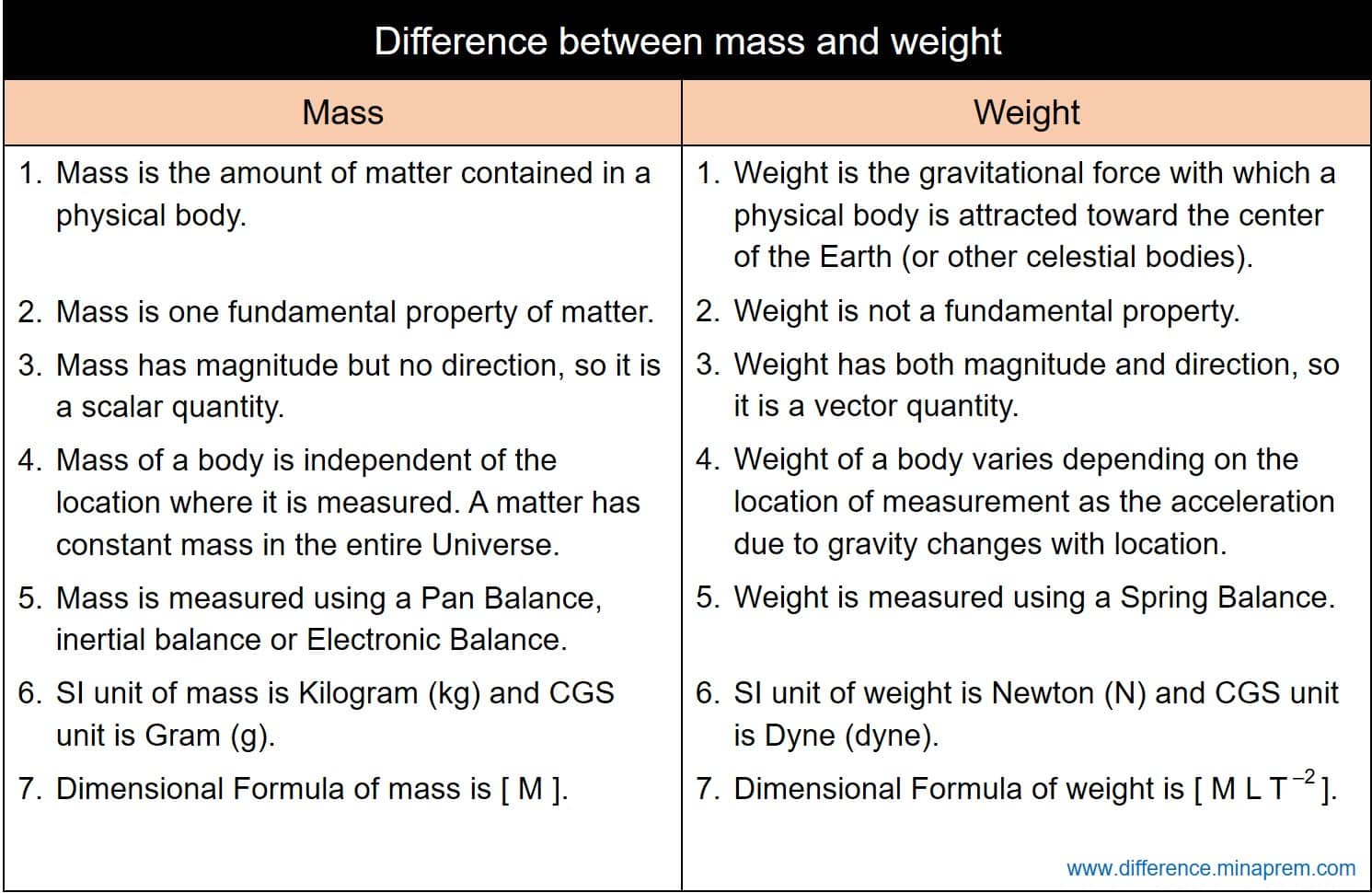
Mass, often denoted by the symbol 'm', is a measure of the amount of matter in an object. It is a fundamental property of an object that remains constant regardless of its location or circumstances. In other words, mass is an intrinsic property that cannot be altered by external factors, such as gravity or pressure. The unit of mass is typically measured in kilograms (kg) or grams (g) in the International System of Units (SI).
On the other hand, weight, often denoted by the symbol 'w', is the force exerted on an object due to gravity. It is a measure of the gravitational pull that an object experiences, and it varies depending on the location and the object's mass. Weight is usually measured in newtons (N) or pounds-force (lbf). While mass remains constant, weight can change depending on the gravitational field an object is in.
Gravitational Considerations
Gravity plays a significant role in the difference between mass and weight. As mentioned earlier, weight is the force exerted on an object by gravity, which is why it varies depending on location. For example, an astronaut on the Moon would weigh less than on Earth due to the Moon's lower gravity. However, their mass remains the same; the difference lies in the gravitational force acting upon them.
To illustrate this point, consider the following:
* An object with a mass of 1 kg on Earth weighs approximately 9.8 N due to the gravitational force exerted by the Earth.
* On the Moon, the same object would weigh about 1.62 N, as the Moon's gravity is approximately one-sixth that of Earth's.
* However, the object's mass remains 1 kg throughout, unaffected by the change in gravitational field.
Units and Measurements
Understanding the units and measurements of mass and weight is crucial for accurate calculations. While mass is typically measured in kilograms or grams, weight can be expressed in various units, including newtons, pounds-force, or even ounces-force.
The SI system is widely adopted in scientific and engineering applications, where mass is measured in kilograms (kg) and weight is measured in newtons (N). However, in everyday contexts, weight is often measured in pounds-force (lbf) or kilograms-force (kgf). It's essential to be aware of the units used in different contexts to avoid confusion.
Practical Applications
The distinction between mass and weight has significant implications in various fields, including:
*
Astronomy
* In space exploration, understanding the difference between mass and weight is crucial for accurately calculating orbits, trajectories, and fuel requirements. The mass of an object remains constant, but its weight can change depending on its location in space.
*
Medicine
* In medical contexts, weight is often used as a proxy for body mass, but it's essential to note that weight can fluctuate due to factors like water retention or changes in muscle mass. Mass, on the other hand, remains a constant measure of an individual's body composition.
*
Cosmology
* In the study of the universe, mass is a fundamental concept that helps us understand the behavior of galaxies, stars, and other celestial objects. Weight, however, is less relevant in this context, as it depends on the gravitational field, which is not a fixed property of the universe.
Conclusion
In conclusion, mass and weight are two distinct concepts that are often confused with each other. Understanding the fundamental difference between them is crucial for accurate calculations, scientific research, and everyday applications. By recognizing the role of gravity in weight and the intrinsic nature of mass, we can better appreciate the complexities of the physical world. As physicist Stephen Hawking once said, "The fundamental laws of physics are not unique, but the constants of nature are unique." The difference between mass and weight is a testament to the intricate and fascinating world of physics.



Related Post

Mercadante Funeral Home Chapel Worcester: A Legacy of Compassionate Service

The Enduring Value of Conviction: Lessons from the Indomitable Duo of Manny and Diego

The Enigma of Naina Sree: The Most Beautiful Woman In The World, According To Data

The Inside Scoop on NYPD Precincts: A Guide to the City's 77 Law Enforcement Hubs