Cracking the Code on FV: Unlocking the Power of Future Value in Finance
Cracking the Code on FV: Unlocking the Power of Future Value in Finance
The concept of future value (FV) is a staple in the world of finance, enabling individuals and businesses to estimate the growth of investments, predict returns on capital, and make informed financial decisions. In essence, future value is the anticipated dollar value of a sum at a future point in time, taking into account factors such as compounding interest, inflation, and time value of money. Understanding FV is crucial for making smart financial choices and achieving long-term financial goals.
In this article, we'll delve into the meaning and significance of future value in finance, highlighting its applications, formula, and limitations. We'll examine real-life scenarios, expert insights, and case studies to demystify the concept of FV and provide actionable tips for its effective use.
The Formula and Mechanics of Future Value
The basic formula for calculating future value is:
FV = PV x (1 + r)^n
Where:
- FV is the future value of the investment/loan
- PV is the present value (the initial amount)
- r is the interest rate (expressed as a decimal)
- n is the number of periods (years/months/quarters) the money will be invested or borrowed for
The formula is built on the concept of compounding interest, where the interest earned in each period is added to the principal amount, resulting in exponential growth over time.
The Role of Compounding Interest
Compounding interest is a key driver of FV growth. As shown in the following example:
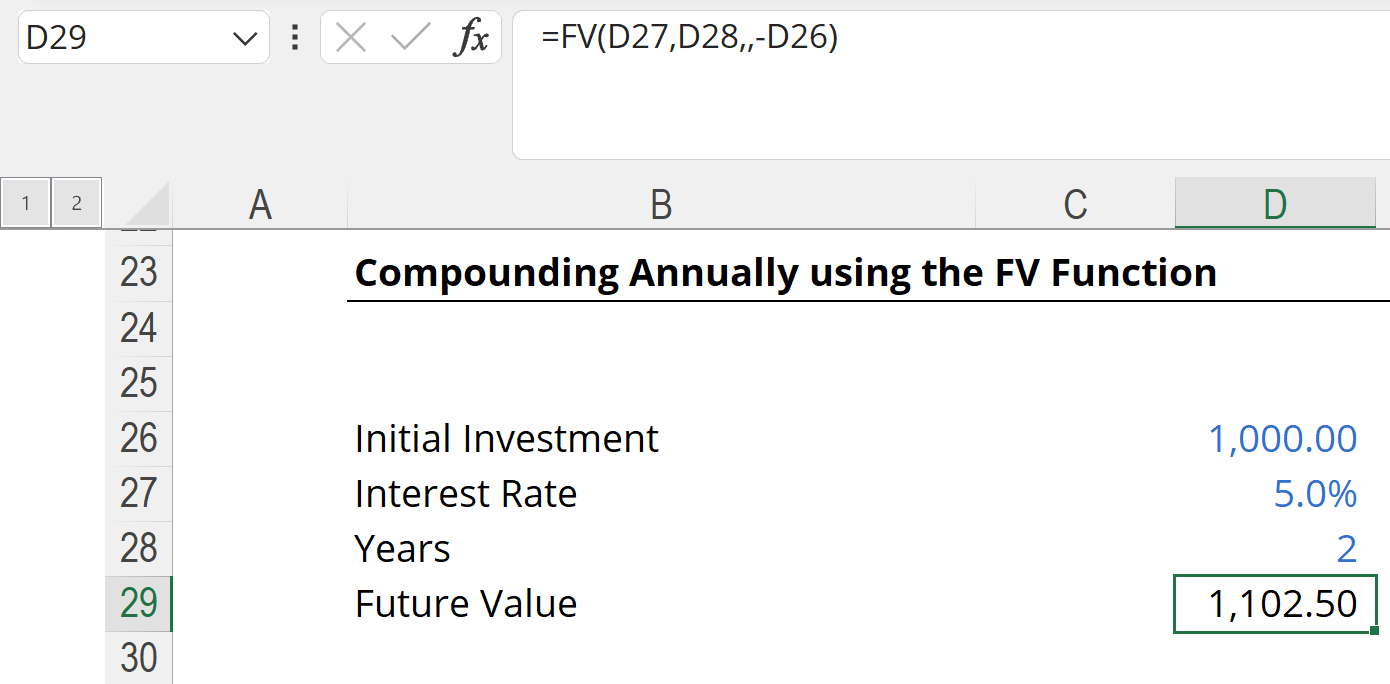
Suppose you deposit $1,000 into a savings account earning an annual interest rate of 5%. After one year, the interest earned is $50, resulting in a balance of $1,050. In the second year, the interest is calculated on the new balance of $1,050, not just the initial $1,000, leading to a further $52.50 in interest and a total balance of $1,102.50. This process continues, with interest earning interest, resulting in a compounding effect that significantly boosts the FV.
This illustrates why compounding interest is essential for FV growth: it leverages the power of time, interest rates, and regular investments to produce remarkable results.
Applications of Future Value:
1. **Investments**: Calculating FV helps investors estimate potential returns on stocks, bonds, or real estate investments, enabling informed investment decisions.
2. **Loans**: Assessing FV helps borrowers determine the total cost of loans, including interest and fees.
3. **Savings**: Estimating FV enables individuals to plan for long-term goals, such as retirement savings or education expenses.
4. **Tax Planning**: Understanding FV can assist in minimizing taxes through smart investment and retirement planning strategies.
Expert Insights:
According to financial expert and author, Suze Orman: "FV is the linchpin of any investment strategy. By understanding how FV works, you can make informed decisions and achieve your financial goals."
Real-Life Scenarios: Putting FV into Practice
Let's examine a few real-life scenarios to illustrate the importance of FV in finance:
**Scenario 1: Savings for a Down Payment**
John wants to save $20,000 for a down payment on a house in 5 years. Assuming an annual interest rate of 2.5% compounded quarterly, John can calculate his FV using the formula:
FV = $20,000 x (1 + 0.02)^20 ≈ $23,629.19
By taking into account the time value of money, John can plan his savings strategy to meet his goal.
**Scenario 2: Investing in the Stock Market**
Emily invests $5,000 in a stock that earns an average annual return of 8%. With quarterly compounding, Emily can calculate the FV of her investment:
FV = $5,000 x (1 + 0.02)^40 ≈ $10,319.91
FV calculation helps Emily understand the potential growth of her investment, allowing her to make informed decisions about her portfolio.
**Scenario 3: Retirement Planning**
David, age 35, wants to estimate his retirement savings at age 65. Assuming an annual rate of return of 6% and a 30-year investment horizon, David can calculate his FV:
FV = $50,000 x (1 + 0.06)^30 ≈ $243,919.29
By understanding his FV, David can create a comprehensive retirement plan, taking into account his expected expenses and desired lifestyle.
Limitations of FV:
While FV is a powerful tool, it's essential to acknowledge its limitations:
1. **Assumptions**: FV calculations rely on assumptions about interest rates, time horizons, and compounding frequencies.
2. **Market Fluctuations**: Market downturns can impact FV growth, while market upswings can boost it.
3. **Taxes and Fees**: FV calculations often ignore taxes, fees, and other expenses that can significantly affect actual returns.
Key Takeaways:
1. **FV is a crucial concept** in finance, enabling informed investment, loan, and savings decisions.
2. **Compounding interest** drives FV growth, making it essential for long-term financial success.
3. **Expert insights** can provide valuable guidance when applying FV in real-life scenarios.
4. **FV is a dynamic concept**, requiring regular reassessment and adjustment to accommodate changing market conditions and personal goals.
By grasping the fundamentals of FV and its practical applications, individuals can make data-driven decisions, achieve financial goals, and secure a brighter future.



Related Post

Unpacking Sha'Carri Richardson's Remarkable Age: A Deeper Dive

Rising Star of Canadian Literature: Unveiling the Life and Achievements of Jacqueline Robertson's Inspiration Jacqueline Rickard's (Corrected Name) Career

Unveiling the Enigma of George Soros: The Billionaires Story of Making and Losing Fortunes

The Rise of Leanne Stokes: From Humble Beginnings to Becoming a Sensation on Real Housewives of Dallas